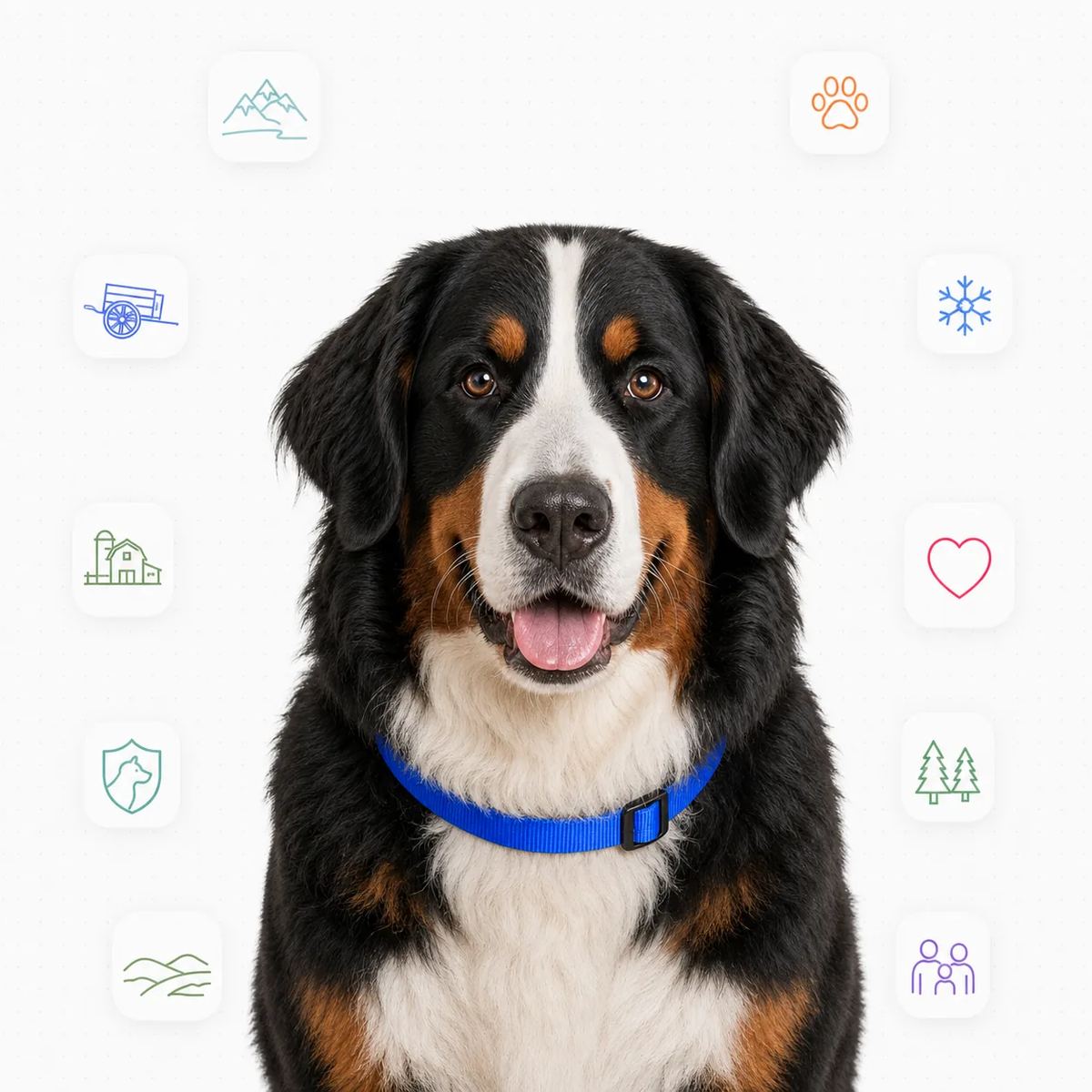
Bernese Mountain Dog portrait
Bernese Mountain DogWorking Group
Built for Bernese Mountain Dog breeders

Built for Breeders With a Year-Long Berner Waitlist

Berner families find you long before a litter exists, ask how long the grandparents lived, and wait patiently as long as they hear from you. Whelpify gives your program a real website, a waitlist that spans litters, and deposits through your own Stripe account, with no marketplace cut.

Typical litter6to 10 pupsBig, heavy puppies and a big whelping box
AKC popularityTop 25Demand for well-bred puppies outruns supply in most regions
Life expectancy7to 10 yearsLongevity in the line is the first thing buyers ask about
Go-home8to 10 weeksMany Berner programs hold puppies a little longer
About the breed

A Swiss Farm Dog With a Waiting List, and a Health Story Buyers Already Know

The Bernese Mountain Dog is one of the four Swiss Sennenhund breeds, developed around the canton of Bern as a general-purpose farm dog that drove cattle, pulled carts to market, and watched the yard. Swiss fanciers revived the breed in the early 1900s, and the AKC recognized it in 1937. It sits in the Working Group and, for a large tricolor dog that sheds year-round, it is remarkably popular.

Berner buyers are patient and well-read. They have usually visited the parent club's site, know that the breed averages 7 to 10 years, and will ask how long the grandparents lived before they ask the price. They expect to see hips, elbows, eyes, and heart on both parents, a vWD result, and a breeder who can talk frankly about cancer in the pedigree. Well-bred puppies are spoken for long before they are born.

The breed's defining health problem is histiocytic sarcoma, an aggressive cancer that is the leading cause of death in the breed, alongside the more familiar large-breed list of hip and elbow dysplasia, bloat, and inherited eye disease. The Bernese community responded with Berner-Garde, an open health and pedigree database that serious buyers know how to read, and responsible programs screen every generation and enter the results.

Breeding Berners today

What the Market Looks Like Right Now

Honest context for planning a litter. These are the ranges we see on public listings and in parent club guidance; your region, your lines, and your reputation move them.

Typical pet price$2,000 to $4,000Limited registration, fully screened parents, and documented longevity in the pedigree move a program toward the top of the range.
Litter size6 to 10Averages near eight, with singletons and litters of twelve both happening. Puppies are big at birth, often close to a pound.
Gestation63 daysFrom ovulation. Progesterone timing is common, and many breeders book the reproductive vet for the due date just in case.
Deposit norms$500 to $1,000Commonly $500, applied to the balance and non-refundable once a puppy is matched, with the balance due at or before go-home.
Waitlist length6 to 18 monthsDemand outruns well-bred supply almost everywhere. Many families wait through more than one litter.
What buyers ask firstLongevityHow long the parents' relatives lived, then hips, elbows, eyes, heart, and vWD, then cancer history and Berner-Garde entries.

Whelping Notes for Berners

  1. Berner dams are big and can be careless in the box. A roomy whelping box with pig rails and close supervision for the first week prevents the crushing losses large breeds are known for.
  2. Heat is the enemy. Keep the whelping room cool, watch the dam closely in summer, and tell families plainly that a Berner is not a dog for July hiking.
  3. Slow, controlled growth matters. Large-breed puppy food, no forced exercise or stairs, and a lean body condition through the first eighteen months protect the hips and elbows you worked to clear.
  4. Record everything for Berner-Garde. The breed's open health database is how serious buyers check a pedigree, and a program that feeds it is a program they trust.
Why Berner breeders pick Whelpify

A Berner Program Is a Long Relationship, So Start It Organized

Three things a Berner breeder spends real time on, and how Whelpify handles each one out of the box.

01 / Waitlist

A List That Outlasts the Litter

Berner families apply a year ahead and wait through a litter or two. Every application lands in one list with a position, a status, the family's preferences, and notes. Set a follow-up reminder so nobody goes quiet for six months, and when the litter is born the interested families are notified from the dashboard.

01The HalvorsensApplied Sep 2025 · female, any litter#1 · Deposit paid
02A. BrennanApplied Nov 2025 · male, fall 2026#2 · Approved
03Ruiz familyApplied Jan 2026 · any sex, has a Berner#3 · Approved
04T. MackenzieApplied Mar 2026 · first Berner#4 · Follow up
02 / Health

Clearances and Longevity, on Every Parent Page

Attach OFA hips, elbows, eye and cardiac exams, the vWD and DM results, and uploaded certificates to the sire and dam once. Every litter and puppy page shows the parents' screening beside their photos and three-generation pedigree, and your own words about longevity in the line sit right next to it.

OFA hipsGood
OFA elbowsNormal
Eyes (annual)Normal
CardiacNormal
vWD type 1Clear
DM (SOD1)Carrier
03 / Updates

Nine Weeks of Updates Without the Group Text

Announce the litter before it is born, notify interested families the day it arrives, and post weights and photos on each puppy as they grow. Offers go out with a response window, balances on a date you choose, and contracts get signed from a phone. The litter page updates itself every time you do.

Day 0Litter born, interested families notified
Day 7First weights and photos on each puppy
Day 21Eyes open, litter page updated
Day 42Offers sent with a response window
Day 49Deposits in, contracts signed online
Day 63Balances paid, go-home
Health testing

Screen Everything, and Talk About Cancer Anyway

The Bernese Mountain Dog Club of America asks breeders to evaluate hips, elbows, eyes, and heart on both parents and to DNA test for von Willebrand disease, with the results recorded at OFA. Buyers in this breed tend to check, and they tend to check Berner-Garde as well.

CHIC (Canine Health Information Center) issues a number when a Berner has the parent club's required results on file with OFA. No clearance exists for histiocytic sarcoma; a genetic risk index is offered by one European lab and some breeders use it, but it is a risk estimate, not a pass or fail. Honest pedigree longevity data is still the best tool the breed has.
Each dog record has a health section for results, registry numbers, and uploaded certificates. The public parent page shows what you choose to publish, and every puppy from that pairing links back to it.

Hips

OFA evaluation at 24 months or older (or PennHIP). Fair, Good, or Excellent are passing grades.

Elbows

OFA elbow radiographs at 24 months or older, graded Normal or by dysplasia grade.

Eyes

Exam by a board-certified veterinary ophthalmologist, recorded through the OFA eye certification registry, watching for cataracts, PRA, and entropion or ectropion.

Cardiac

Auscultation or echocardiogram by a veterinary cardiologist at 12 months or older, recorded with OFA.

Von Willebrand Disease (vWD Type 1)

DNA test for the bleeding disorder found in the breed. Carriers are unaffected and can be bred to clear partners; affected dogs need extra care around surgery.

Degenerative Myelopathy (DM)

DNA test for the SOD1 mutation, commonly added to the panel. Two copies mean the dog is at risk later in life; carriers are fine bred to clear partners.

Everything under the hood

Set Up the Way a Berner Program Runs

The full platform is included on every plan. Here is how the pieces map to a Berner breeder's year.

Families Notified the Day the Litter Arrives

Announce a litter before the puppies are born, let families register interest, and notify them from the dashboard when the litter is whelped. When a puppy goes available, matching families hear first.

Clearances Where Buyers Look for Them

Hips, elbows, eyes, heart, vWD, and DM attach to each parent once and show on every litter and puppy page, with uploaded certificates for anyone who wants to read the fine print.

Offers With a Deadline That Enforces Itself

Offer a specific puppy to a specific family, set a response window, and let the reminders go out on their own. If the family passes, the next match on the list hears about the puppy.

Photos and Weights, Per Puppy

Log weekly photos and weights on each puppy record. A family waiting a year gets a litter page that grows with the puppies, not a group text with fourteen people in it.

Contracts Families Sign From Their Phone

Your purchase agreement, health guarantee, spay and neuter timing, and any return-to-breeder clause become a signable form attached to each family's file, with copies on both sides.

Your Kennel Name, on Your Own Domain

Connect a domain you already own or buy one from the dashboard, with SSL handled for you. Your whelpify.com address keeps working alongside it.

How a Berner program actually runs

Few Litters, Long Lists, and Families Who Stay in Touch for a Decade

The rhythm of a Berner program is particular. These are the numbers the workflow is shaped around.

Typical litter
6to 10 pups

Every puppy gets its own page, status, weights, and deposit record from birth.

Waitlist span
2litters or more

Families routinely wait through a litter. Statuses, positions, and reminders keep the list honest.

Health focus
OFA· vWD · DM

Hips, elbows, eyes, heart, and DNA results attach to parents and appear on every puppy page.

Buyer question
longevity

Room on every dog page to say, in your own words, how long the line lives.

Update cadence
weekly

Weigh-ins, photos, and litter page updates are what keep a year-long waitlist calm.

Deposit strategy
per-pup· $500 or more

Offers with a response window, automatic balance requests, and receipts for every payment.

Bernese Mountain Dog FAQ

Questions We Get From Bernese Mountain Dog Breeders

How does Whelpify handle a Bernese waitlist that spans more than one litter?

Every applicant sits in one numbered list with a status, their preferences, and notes. When a litter is born you offer specific puppies to specific families with a response window, and anyone who passes stays on the list for the next litter without re-applying.

Can I show OFA hips, elbows, eyes, heart, and the vWD and DM results for each parent?

Yes. Each dog record has a health section where you enter results and registry numbers and upload certificates. What you publish appears on that dog's public page and on every litter and puppy page that descends from it.

Can I announce a litter before it is born and notify families when it arrives?

Yes. Create the litter from the sire and dam pairing, publish the announcement page, and let families register interest. When the puppies arrive you notify the interested families from the dashboard, and the litter page fills in as you add puppies.

Can families pay a larger deposit and the balance closer to go-home?

Yes. You set the deposit amount per offer and request the balance on the date you choose, by card through your own Stripe account or by invoice for Zelle, Venmo, PayPal, Cash App, or check. Each sale shows a paid-versus-remaining bar.

Can my contract include a return-to-breeder clause and spay or neuter timing?

Yes. Your contract becomes a signable online form with your terms shown word for word. Families sign with a typed legal name and date from their phone, and both sides keep a signed copy.

Can I track heat cycles for my females?

Yes. Each female has a heat-cycle tab with her history, a timeline of where she is in the current cycle, an estimated fertile window, and an email and dashboard reminder before her next heat is due.

30-day free trial

Set Up Your Bernese Mountain Dog Program the Way You Actually Run It

Every plan starts with a 30-day free trial and includes the full platform. Most breeders have a site up in an afternoon.