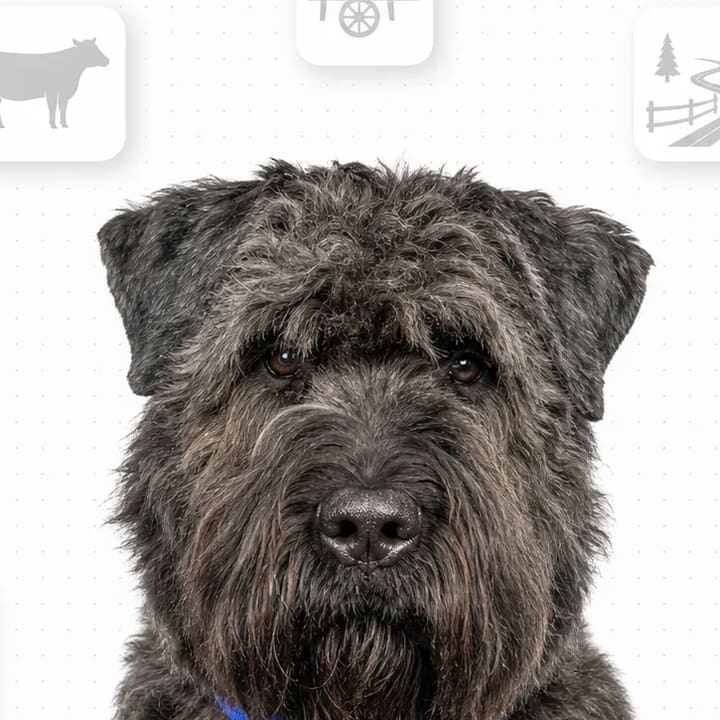
Bouvier des Flandres roughly means cowherd of Flanders, and the farmers of northern France and the Low Countries kept one dog to drive cattle, guard the farm, and pull carts rather than a team of specialists. The breed was first shown in Brussels in 1910, survived World War I largely because the Belgian army kept it, and was nearly lost again after World War II. The AKC recognized it in 1931, the American Bouvier des Flandres Club formed in 1963, and the breed ranked No. 100 in the AKC's 2025 list.
Bouvier buyers usually come knowing the look: a powerful, square dog with a tousled double coat, beard, and mustache. The standard allows any color from fawn to black, through salt and pepper, gray, and brindle, with a small white star on the chest, and severely penalizes chocolate brown, white, and parti-color. The standard calls for a docked tail leaving 2 or 3 vertebrae, and ears may be cropped or left natural, so many families ask about both. The AKC is clear that a Bouvier needs a job and an active owner; a bored one can be destructive.
The AKC gives a life expectancy of 10 to 12 years. Responsible breeders screen for hip and elbow dysplasia, eye disease including glaucoma and cataracts, and subaortic stenosis, and the AKC also lists hypothyroidism, laryngeal paralysis, megaesophagus, and Bouvier des Flandres myopathy among the conditions to watch. Like other large, deep-chested breeds, Bouviers can bloat, and the AKC notes that growing puppies need a diet lower in protein than most breeds and limits on heavy exercise.