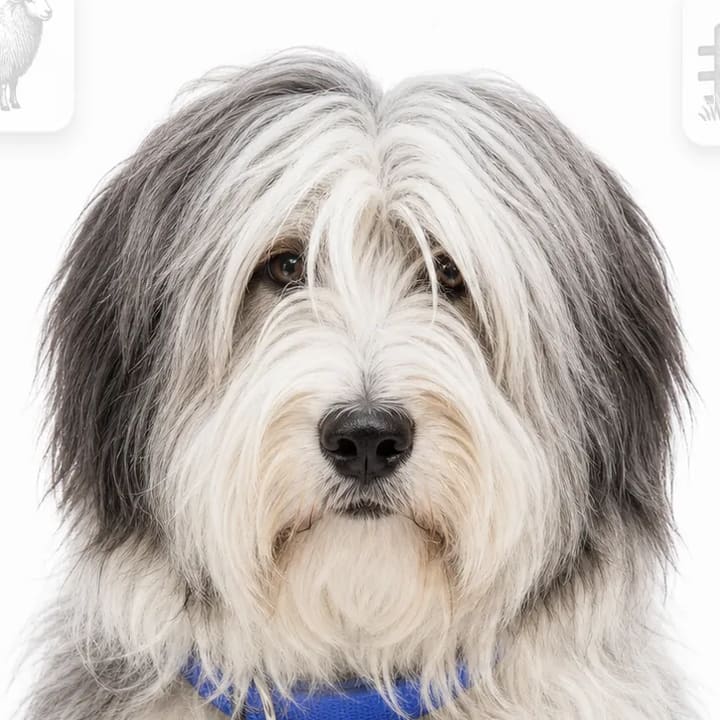
The PON takes its nickname from its Polish name, Polski Owczarek Nizinny. It is believed to descend from dogs the Huns brought into central Europe crossed with local stock, and it was bred to herd flocks by day and guard them at night. Traders took PONs to Scotland in the 1500s, where they are thought to have helped form the Bearded Collie. The Polish Kennel Club and the FCI accepted the first standard in 1959, the AKC recognized the breed in 2001, and it ranked No. 192 in the AKC's 2025 list.
Buyers notice the coat first: a long, dense, shaggy double coat with hair hanging over the eyes, shown natural and never scissored. All coat colors are acceptable, most often white with black, gray, or sandy patches, gray and white, or chocolate. Most PONs carry a dominant fading factor, so puppies are born darker than they will be as adults unless they are born white. The tail is naturally short or docked, no longer than two vertebrae.
The AKC gives a life expectancy of 12 to 14 years and describes the breed as generally healthy, with hip dysplasia the main screening. The OFA database also holds a DNA result worth knowing: of 395 PONs tested for rcd4 progressive retinal atrophy, 15.9 percent are affected and more than half are carriers. The club strongly suggests a thyroid panel on every dog before breeding. The AKC adds that PONs can be stubborn and suspicious of strangers and recommends early socialization and puppy classes.