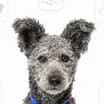
The breed began in the 1960s, when small Australian Shepherds working the U.S. rodeo circuit were bred selectively to bring the size down further. They were first called Miniature Australian Shepherds, and they spread across the country with equestrians who wanted a bright, loyal dog that traveled well to horse shows. The Miniature American Shepherd Club of the USA became the AKC parent club in May 2011, the breed entered the AKC Stud Book and the Herding Group in 2015, and it ranked 28th in AKC registrations for 2025.
Buyers ask about color, eyes, and size, usually in that order. The standard recognizes black, blue merle, red, and red merle, with or without white and tan (copper) markings, and accepts brown, blue, hazel, or amber eyes in any combination. Size is a disqualification in both directions: dogs stand 14 to 18 inches and bitches 13 to 17, so a family asking for something smaller is asking for a dog outside the standard. Tails are traditionally docked or natural bobtail.
The AKC describes the breed as generally healthy, with a life expectancy of 12 to 13 years. The conditions the parent club tests for are hip dysplasia, inherited eye disease, the MDR1 drug-sensitivity mutation, PRA-prcd, HSF4 hereditary cataracts, and neuroaxonal dystrophy (NAD). MDR1 matters most in daily life: Washington State University lists the miniature at roughly half of dogs carrying the mutation.