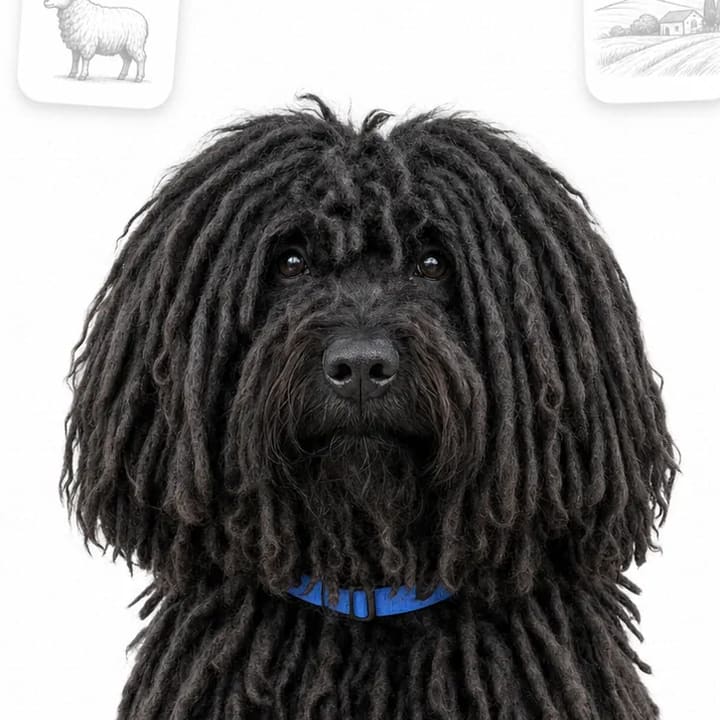
The Puli came into Hungary with the Magyars more than 1,000 years ago and herded large flocks on the plains, working alongside the Komondor that guarded them. Modern breeding traces to Dr. Emil Raitsits, who began rebuilding the breed in 1912 and wrote the first standard in 1915. The AKC recognized the Puli in 1936, the Puli Club of America was founded in 1951, and the breed ranked No. 177 in the AKC's 2025 list.
Puli buyers arrive for the coat. The dense, weatherproof double coat forms cords in the adult if it is left to develop, and the standard lets a Puli be shown corded or brushed. Color is simpler than it looks: the AKC standard accepts only the solid colors black, rusty black, all shades of gray, and white, with a white chest spot of no more than 2 inches. The club also tells buyers to expect barking and a dog that needs real daily interaction.
The AKC gives a life expectancy of 10 to 15 years and calls the Puli generally hearty and healthy. The conditions the Puli Club of America screens for are hip dysplasia, eye disorders, patellar luxation, and degenerative myelopathy (DM), a late-onset disease that the club says appears at 7 years and up and is incurable. Elbows, cardiac, thyroid, and hearing tests are optional.